

The Ultimate Hybrid and Federated Enterprise Historian Architecture for Modern Manufacturing
Bring Your Own Hardware (BYOH): Maximum Flexibility for Your Industrial Data.
Factorian Historian now supports seamless installation on your existing VM infrastructure. Build a distributed network by mixing and matching Factorian’s rugged fanless devices with your own virtual machines. This hybrid approach offers unparalleled flexibility across your entire manufacturing footprint.
1. Unrivalled Deployment Flexibility (BYOH)
Our Bring Your Own Hardware model allows you to deploy the Factorian Historian on your existing VM infrastructure (VMware, Hyper-V, Nutanix) or our own Rugged Fanless Devices or Edge Servers.
- Mix & Match: Run VMs in the data center and rugged nodes on the shop floor.
- Unified Network: One seamless distributed historian across your entire global IT/OT footprint.
2. Performance Without Compromise
Scale your data ingestion without hitting a ceiling. Whether virtual or physical, every node is a powerhouse.
- High-Velocity Ingestion: Up to 15,000 tags per second per node.
- Edge Processing: Localized data handling prevents network congestion and central bottlenecks.
3. Maximized ROI & Reduced CapEx
Leverage the investments you’ve already made.
- Utilize Existing Servers: Install directly onto your current VM clusters to eliminate new hardware costs.
- Lower TCO: Reduce maintenance overhead by managing a virtualized environment alongside physical edge assets.
4. Industrial-Grade Reliability
Built for the realities of the manufacturing floor.
- Distributed store: Automated local archival and federated access ensures zero data loss during network outages.
- Redundant by Design: A distributed network means no single point of failure if one node goes down, the rest of your enterprise keeps moving
Federated Data Architecture
The Factorian Historian can evolve from a single node (either a VM or a small fanless rugged PC) data historian to a fleet of nodes creating a Distributed Federated Network. This architecture prioritizes data sovereignty and speed, allowing you to query massive datasets across global sites without the latency or cost of centralized data duplication.
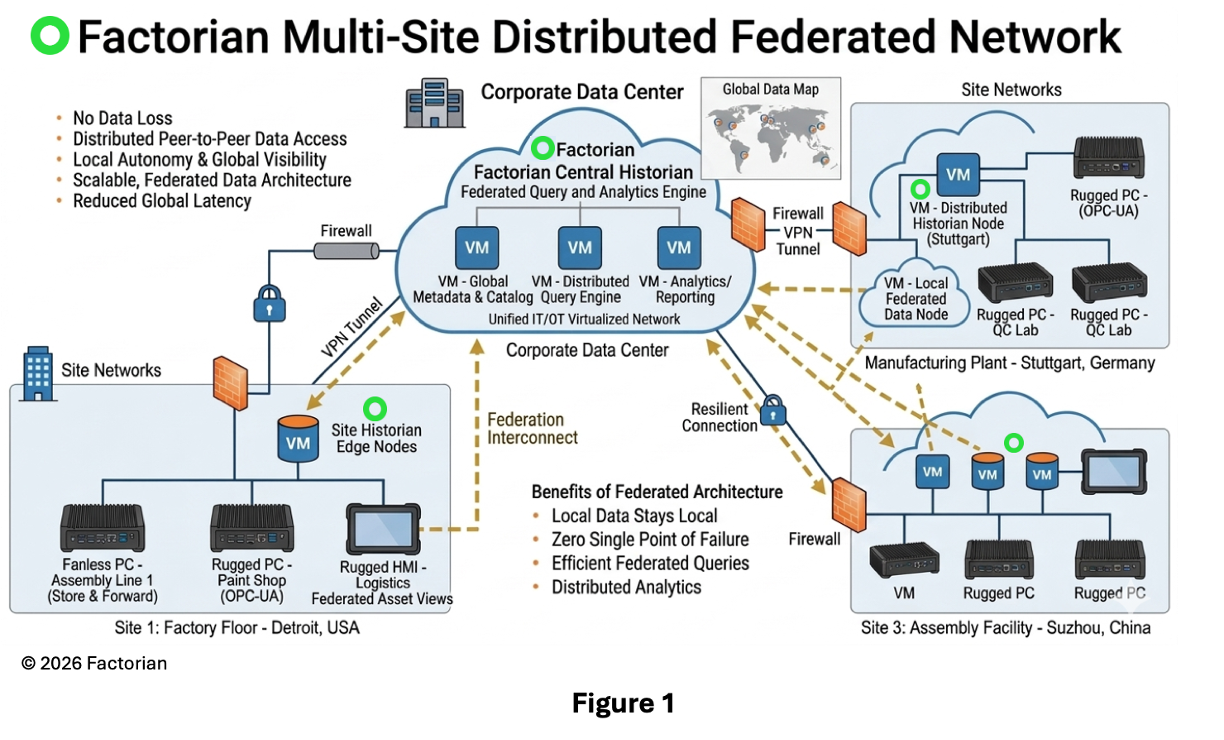
Federated Architecture Overview
Unlike traditional “store-and-forward” systems that push all raw data to a central hub, Factorian’s federated model keeps high-resolution data at the edge.
- Virtual Data Fabric: Create a unified logical view of your data while it remains physically resident on local nodes.
- On-Demand Global Queries: The Federated Query Engine pulls only the necessary results from site nodes in real-time.
- Zero-Copy Analytics: Perform complex cross-site analysis without moving terabytes of data across your WAN.
Federated Node Specifications
| Feature | Specification |
| Ingestion Capacity | 15,000 tags/sec per node (VM or Rugged PC) |
| Data Residency | Configurable (Local-only, Global-cached, or Federated) |
| Query Performance | Peer-to-Peer (P2P) data access for ultra-low latency |
| Network Optimization | Metadata-only syncing to the Global Data Map |
| Interoperability | Native OPC-UA, MQTT, and REST-API |
Key Architectural Benefits
- Local Autonomy & Global Visibility: Sites maintain full control over their local data assets while Corporate gains a bird’s-eye view via the Global Data Map.
- Reduced Global Latency: By querying locally and only transmitting results, you bypass the “bandwidth tax” of traditional cloud historians.
- Zero Single Point of Failure: If the corporate connection drops, local site operations including high-speed HMI views and local analytics remain 100% functional.
- Scalable Hybrid Infrastructure: Seamlessly “federate” new sites by simply adding a VM node to your existing IT stack or dropping in a rugged Fanless PC.
Security & Connectivity
- Encrypted VPN Tunnels: All federated traffic is secured between site firewalls.
- Fine-Grained Access Control: Define which tags are visible to the Global Federated Engine and which remain private to the local facility.
Federated Architecture Breakdown comparing Federated approach with traditional store-and-forward legacy historian approach.
| Feature | Factorian Federated Approach | Store-and-Forward (Legacy Historian) |
| Data Residency | Data stays at the edge | Data is duplicated to the corporate cloud |
| Network Impact | Low; only query results travel the WAN | High; continuous stream of all tag data |
| Real-Time Access | On-demand “Live” queries to edge nodes | Delayed; waits for sync/buffer clearance |
| Storage Strategy | Distributed across VM and Rugged PC local disks | Centralized massive storage at Corporate HQ |
| Governance | Local sites maintain “ownership” of their data | Central IT collects and owns the data |
The federated network architecture visual (Figure 1) clearly demonstrates how your BYOH strategy allows VMs in the Corporate Data Center to act as the “central monitor” (Global Metadata & Analytics) while local sites maintain their own autonomy using a mix of VMs and rugged hardware.
Here is the Cost Comparison focusing on the WAN and infrastructure savings of this specific architecture.
Cost Comparison: Federated vs. Traditional Cloud Historian
| Cost Factor | Traditional Cloud-Streamed Historian | Factorian Federated BYOH |
| WAN Bandwidth | High Cost: Constant 24/7 streaming of all raw tag data. | Ultra-Low: Only metadata and query results travel the WAN. |
| Cloud Storage | Expensive: Paying for TBs of redundant storage in the cloud. | Optimized: Data stays on low-cost local VM/PC storage. |
| Data Egress Fees | High: Every time you pull data back for local reports. | Zero: Data is processed and viewed at the source. |
| Latency/Downtime | Operational Risk: Cloud outages stop site visibility. | Resilient: 100% local uptime during WAN disconnects. |
The “Bottom Line”
By moving to a Federated Hybrid BYOH model, Factorian reduces your total cost of ownership (TCO) by up to 60% compared to traditional cloud-push historians. You eliminate the “Data Tax” of moving bits across the globe while gaining the flexibility to scale your historian as fast as your IT department can spin up a new virtual machine.