
Experiments with frontier LLMs on our Factorian historian MCP server

“Next Frontier” in Batch Manufacturing and Operations.
Sharing results of our recent experiments and the insights we discovered that we think can provide enhanced efficiencies in manufacturing operations. Factorian historian provides a rock solid data foundation upon which LLM assisted chatbots, agents and AI prompts can become an integrated part of manufacturing operations.
Introduction
The batch manufacturing industry stands at the cusp of digital transformation, with advanced data analytics and artificial intelligence promising unprecedented operational efficiency. In a recent experiment, we explored the integration of frontier Large Language Models (LLMs) with the Factorian Historian MCP server, aiming to unlock deeper insights and actionable intelligence for pharma manufacturing operations. This blog post presents the experiment’s results, highlighting how this collaboration elevates operational history discovery, trend analysis, batch tracking, process parameter evaluation, and maintenance planning.
Experiment Setup: Factorian Historian MCP Meets Frontier LLMs
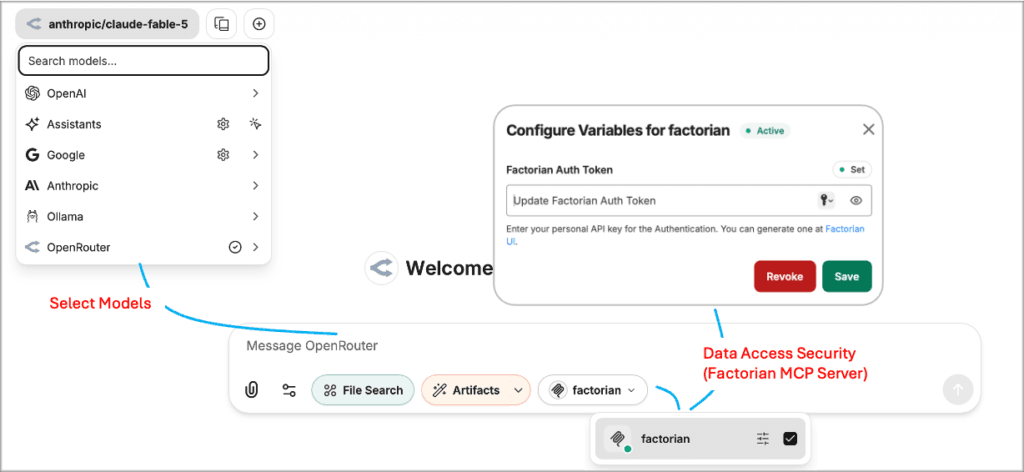
The experiment involved connecting state-of-the-art LLMs to the Factorian Historian MCP – a robust platform that aggregates and stores real-time process data from manufacturing environments. By leveraging the natural language processing capabilities of LLMs, we enabled intuitive querying, rapid trend analysis, and advanced statistical evaluations on historical and live manufacturing data. This setup provided a seamless interface for process manufacturing and plant support professionals to interact with complex datasets without the need for specialised coding skills. Factorian edge platform provides a native chatbot interface running locally within organizational premises providing full data security and ensuring only tokenized information is passed on to the frontier LLMs via chatbot interface. The chatbot interface locally hosted (within Factorian Edge Platform) as a webserver comes pre-installed on the Factorian edge servers also provides interfaces to hook to a host of frontier LLMs and also the option of choosing any opensource LLMs hosted locally by the organization. Factorian MCP server was created with special tools within the MCP server to cater specially to manufacturing operational data and manufacturing events (like Batch, Phases etc.). The Factorian MCP server comes with its own secure access token that is based on user’s access privileges to data in the Factorian historian. This setup ensures full data privacy and security to the organization so that proprietary operational data remains secure and within the bounds of the organization.
Results
Most of the routine operational information with simple data aggregation, history, trending as described below were done exceptionally well at great speed with most of the LLMs.
Routine Operational History Discovery
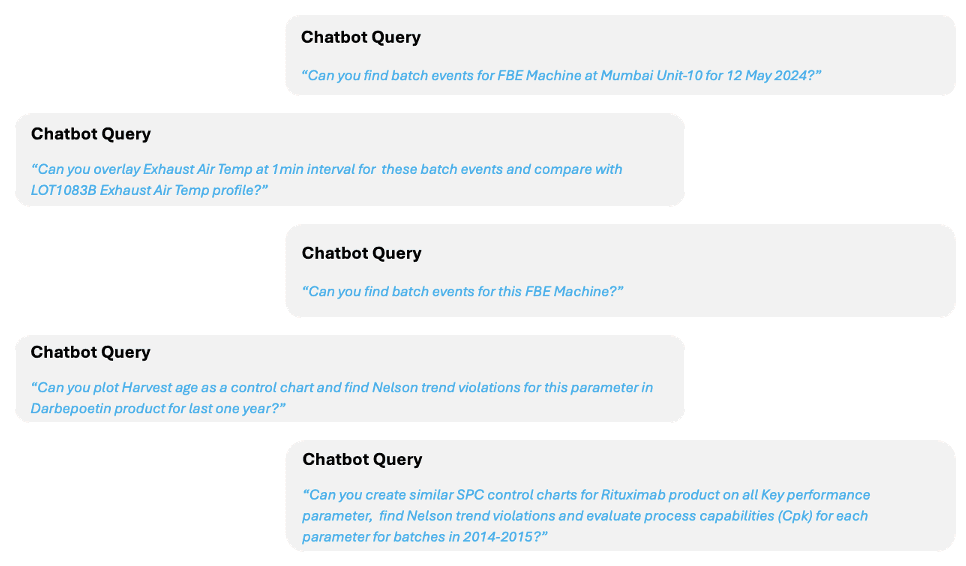
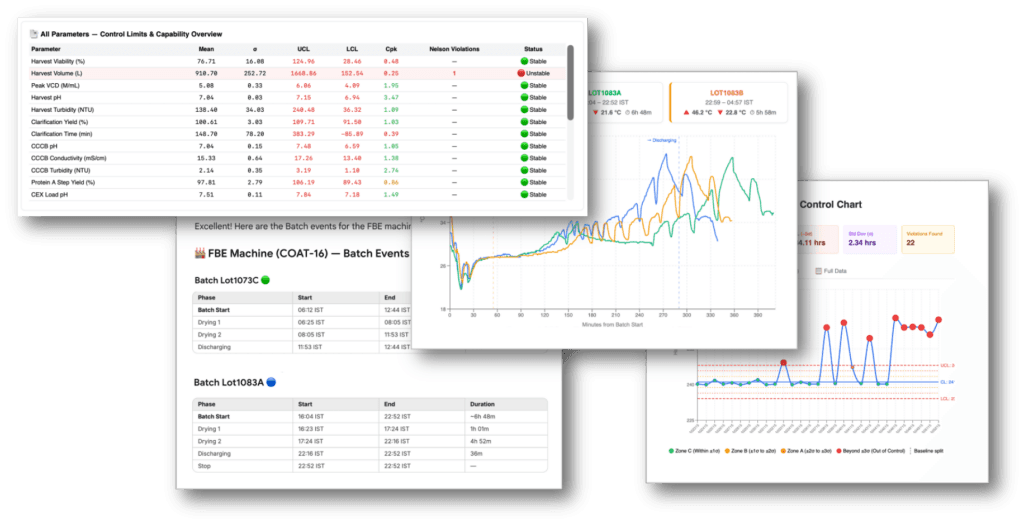
One of the easy low hanging outcomes was the ability of LLMs to easily discover and contextualise operational history using the Factorian MCP server. Through intelligent parsing of historical data streams, the integrated solution identified significant events, batch transitions, and process deviations, presenting them in an easily digestible narrative format. This facilitated quick understanding of past incidents and their impact on overall production, empowering teams to make informed decisions and avoid repeat issues.
- Trend and Batch Analysis: Rapid Insights and Parameter Overlays
Batch tracking was enhanced with dynamic overlays of key and critical process parameters, allowing users to visualise correlations and deviations across production runs. The system flagged notable shifts in temperature, pressure, and ingredient concentrations, helping operators pinpoint root causes of variability and optimise batch consistency.
- Statistical Process Control: SPC Charts and Nelson Trend Violations
The system flagged Nelson trend violations, alerting operators to potential process drifts or anomalies and calculated process capabilities (Cpk). These insights will foster proactive interventions, minimising the risk of non-conformities and ensuring regulatory compliance.
Experiments in Deep Statistical Inquiry
While most of the routine operational information with simple data aggregation, history, trending as described above were done exceptionally well we were more interested in performing more involved deep statistical task from the LLMs and we were equally impressed with the outcomes providing great promise for operational excellence.
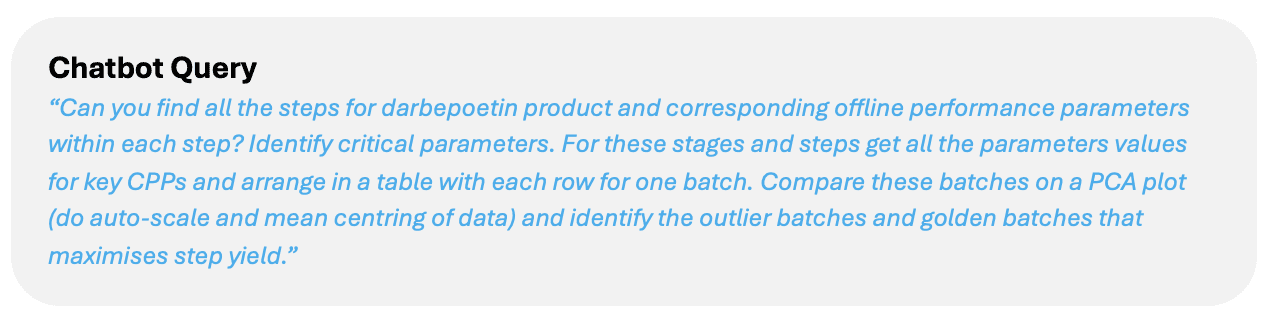
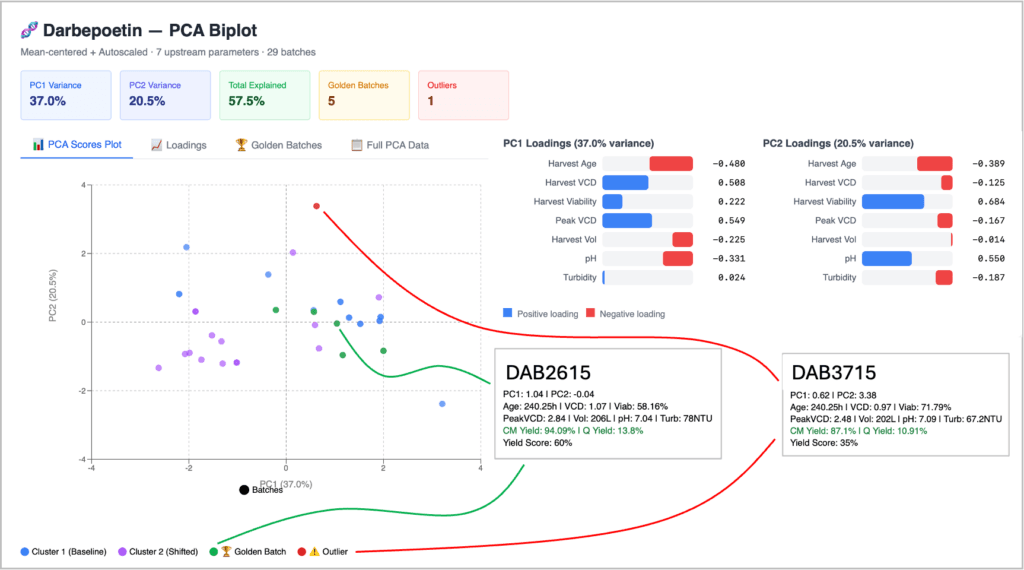
Principal Component Analysis: Outlier Detection and Optimal Batch Selection
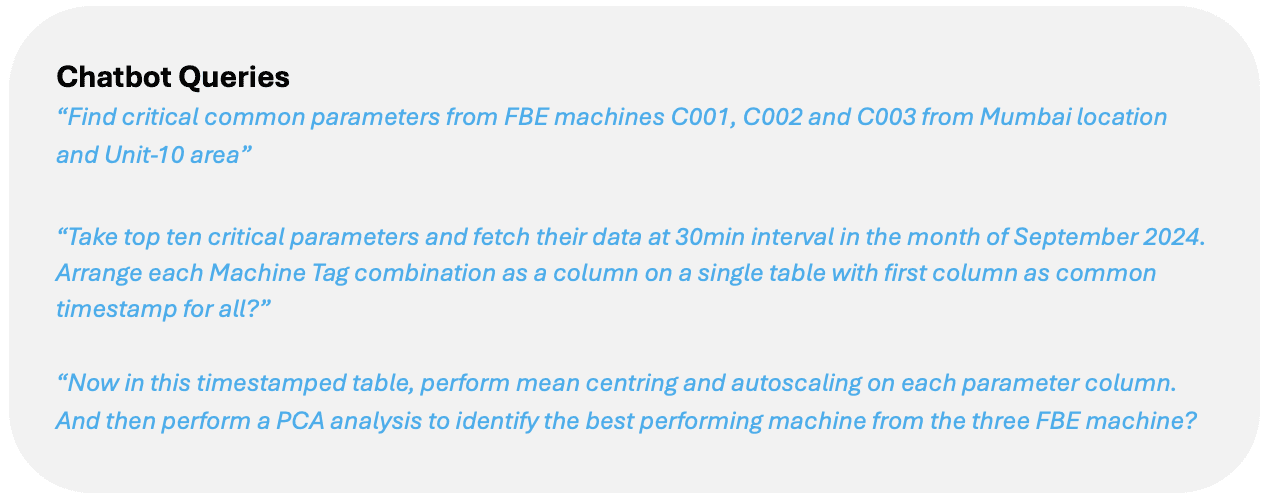
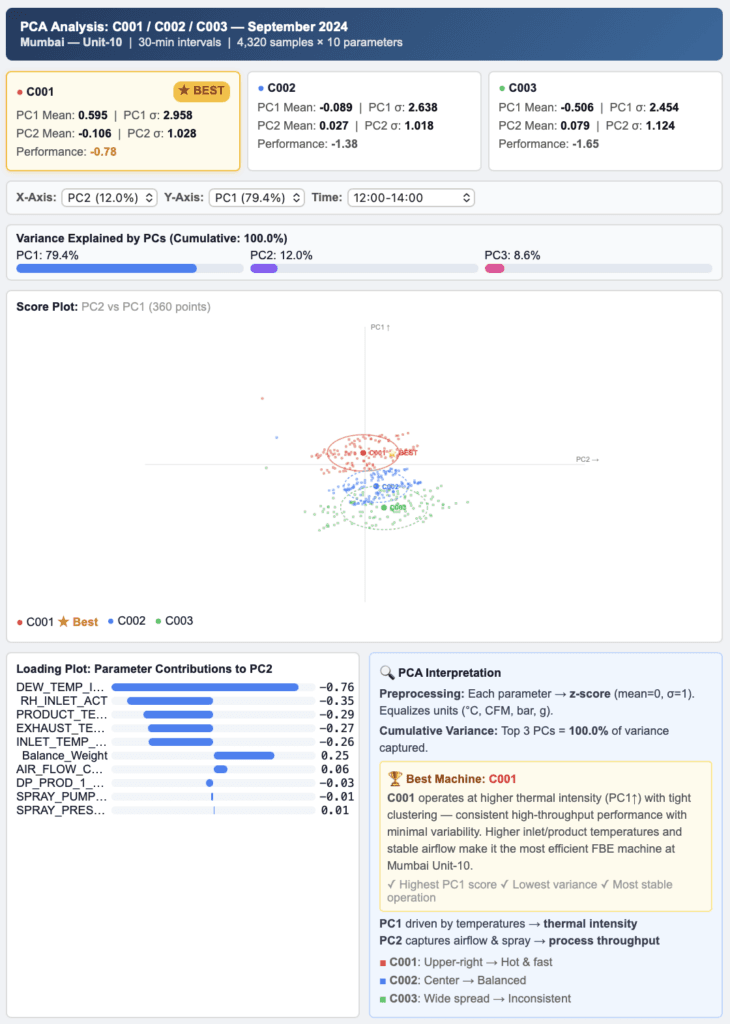
Applying Principal Component Analysis (PCA) on batch performance data, the LLM-integrated platform efficiently detected outlier batches and highlighted those with optimal characteristics. By reducing dimensionality and focusing on the most influential factors, PCA revealed hidden relationships between process variables, guiding process improvement initiatives and supporting robust quality assurance protocols. In another example, we gave process operating parameters timeseries data for a month from three similar machines and compared their performances on a PCA.
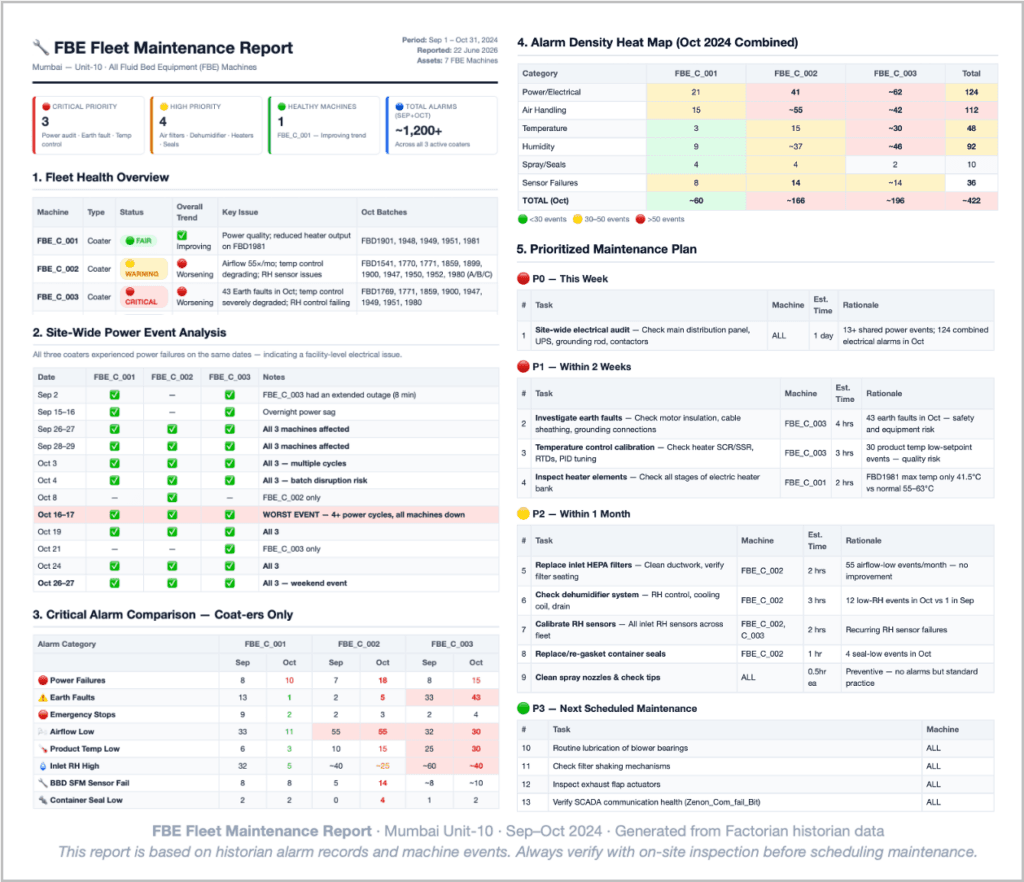
Maintenance Insights: Comprehensive Reports from SCADA Alarms and Events
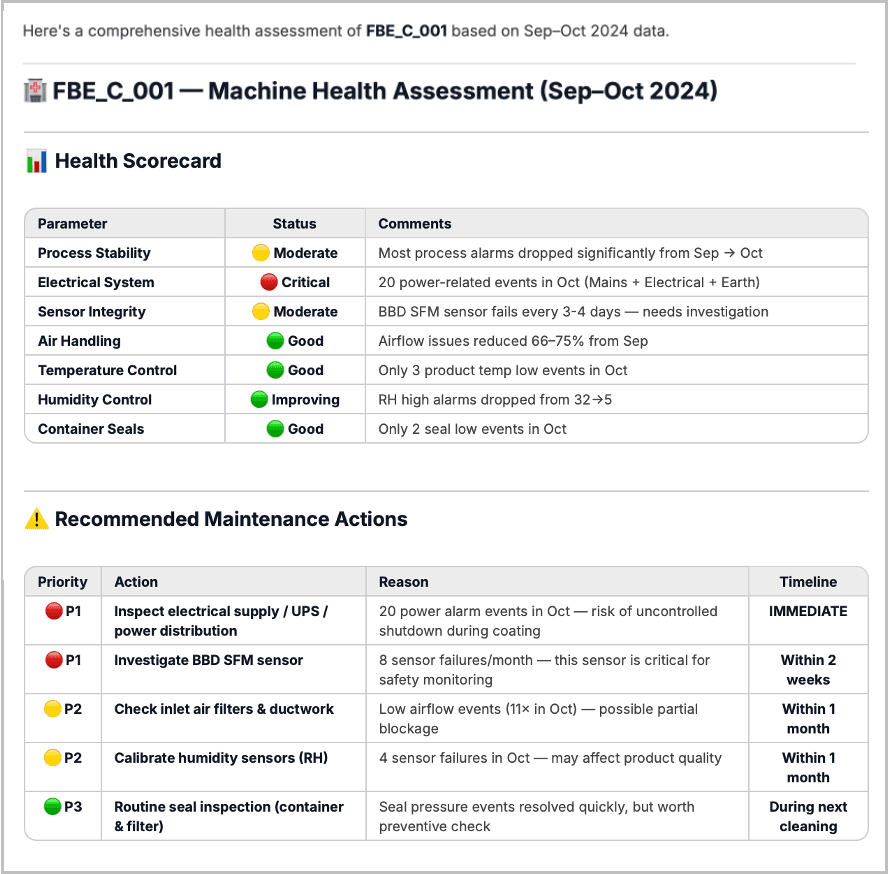
Through analysis of SCADA alarms and event logs that were ingested into the Factorian Historian, LLMs generated comprehensive maintenance reports and actionable suggestions. The platform correlated alarm occurrences with process variables, recommending optimised maintenance schedules and targeted interventions. This predictive approach reduced unplanned downtime and improved asset reliability, supporting smoother production flows and cost-effective operations.


Conclusion: Key Takeaways and Future Potential
The integration of frontier LLMs with Factorian Historian MCP marks a transformative experience for plant engineers in industrial batch manufacturing. The experiment demonstrated not only impressive outcomes across operational history discovery, trend and batch analysis, but also equally well with more involved PCA-driven outlier identification, statistical process control, and maintenance planning. By harnessing AI-driven analytics, plant engineers and managers can unlock deeper insights, enhance decision-making, and drive continuous improvement. The future holds immense potential for “self-service” automation, predictive analytics, and intelligent process optimisation, paving the way for a smarter, more resilient manufacturing ecosystem.
Off course these outcomes shown earlier in this article can be further fine-tuned and directed as these were very preliminary inquiries. With better prompts and refined questions the results can be further enhanced which can then be saved as prompts or even created as AI agents as a self-service by process engineers themselves on the shop floor for repeated use. What makes the LLMs and plant historian MCP integration a game-changer is how it collapses complexity. Gone are the days of forcing teams to learn multiple data analytics tools. A simple secure chat interface running on-premise can now do it all. By allowing AI agents to spin up user-specific prompts as mini-applications, this integration puts power directly back into the hands of plant floor engineers and operators. But tools are only half the battle. To successfully navigate the nightmare of confusing LLM wrapper services flooded now in the marketplace, organizations must invest in upskilling their plant engineers, supervisors and managers with relevant AI skills. Building internal expertise is the ultimate way to demystify the market and build a seamless, future-proof operation. What you need is a good data foundation like Factorian Historian Edge Platform which along with these AI tools you are only limited by your ideas!